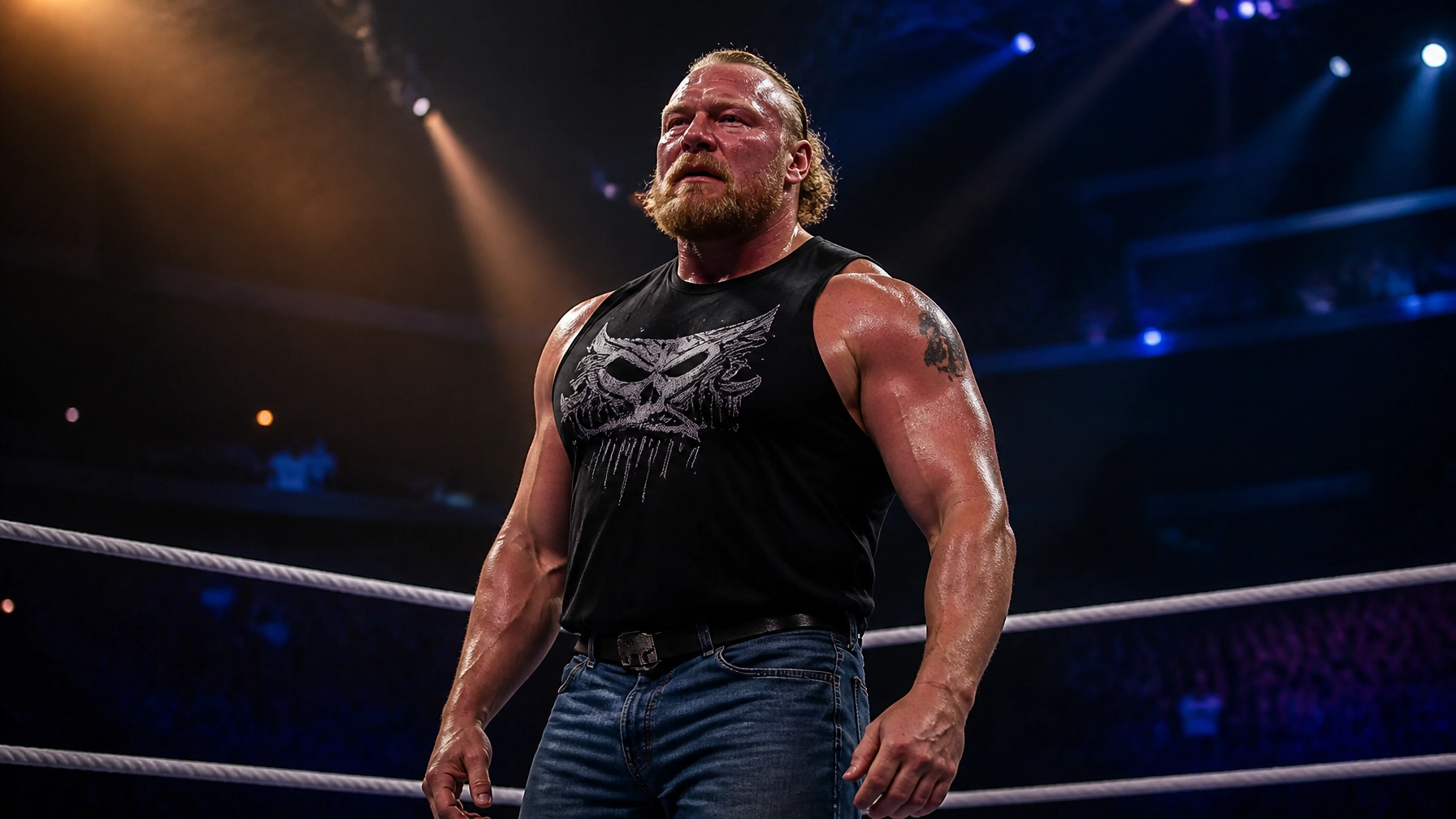
The silence after Brock Lesnar’s defeat was almost as powerful as the violent collision that preceded it.
Standing across from the destructive Oba Femi at SummerSlam 2026, Lesnar appeared to be fighting more than one final opponent. He was battling time, expectation, and the impossible standard created by a career that transformed professional wrestling’s heavyweight landscape. When Paul Heyman later declared that Lesnar was retired “for real this time,” the words landed with the force of a bombshell.
This was not presented as another dramatic pause. It was framed as an ending.
For fans who have watched Lesnar conquer WWE, UFC, and nearly every challenge placed before him, the announcement represents a monumental shift. The Beast Incarnate may have finally walked away from the ring for good.
Paul Heyman’s Statement Changes the Conversation
Paul Heyman has spent much of his career translating Brock Lesnar’s intensity into language. Where Lesnar has often allowed his physical presence to deliver the message, Heyman has provided the grand introduction, the historical framing, and the menacing warning.
That makes his latest statement especially significant.
When Heyman said Lesnar was retired “for real this time” following the SummerSlam loss, he was not merely commenting on a temporary absence. He was drawing a line beneath an illustrious career and asking the WWE Universe to accept that the final chapter had been written.
The wording matters because retirement has surrounded Lesnar before. At previous points, he has appeared ready to leave wrestling behind, only to return when the timing, opponent, or opportunity became impossible to resist. His history has trained fans to question every farewell.
This time, however, Heyman’s message carried a different emotional weight. It sounded less like a storyline tease and more like an acknowledgment of reality.
That does not make a future appearance impossible. Professional wrestling is built on surprises, and Lesnar’s name will always possess enough power to turn an ordinary event into an epic spectacle. But speculation is not confirmation. Based on Heyman’s statement and the presentation surrounding SummerSlam, WWE is treating Brock Lesnar’s in-ring career as finished.
Brock Lesnar Leaves Behind a Legendary Career
Lesnar’s legacy cannot be measured by one championship reign or one unforgettable match. His career has been defined by disruption.
From the moment he arrived in WWE, Lesnar was presented as a rare physical phenomenon: explosive, intimidating, and capable of making established stars look vulnerable. He moved with startling speed for a man of his size, combining amateur wrestling credentials with brutal athleticism and a natural gift for creating danger.
His early rise was meteoric. Lesnar reached the top of WWE while still young, defeating major names and capturing the WWE Championship before many performers have even established themselves as reliable main-event talents. He was not gradually introduced as a future star. He was positioned as one immediately.
Then came the kind of career detour that would have defined most athletes on its own.
Lesnar left WWE and pursued elite competition in mixed martial arts, where he became a legitimate UFC heavyweight champion. That achievement added a new layer to his wrestling persona. He was no longer merely portraying a dangerous competitor; he had proven that his physical power could translate beyond the scripted environment.
When Lesnar returned to WWE, the atmosphere changed. He carried the aura of someone who had nothing left to prove. His matches became exercises in controlled destruction, built around suplexes, sudden bursts of offense, and the ever-present threat of the F-5.
He became a special attraction without becoming a nostalgia act.
That distinction is crucial. Lesnar’s greatest comebacks did not depend solely on memories of his first run. He repeatedly reinvented his place on the roster, whether as a ruthless champion, a calculating antagonist, or an unstoppable force challenging the next generation.
His rivalries with some of WWE’s biggest legends and creative powerhouses produced defining moments across multiple eras. Lesnar was the opponent chosen when WWE wanted a match to feel enormous, violent, and consequential.
Few performers have ever made dominance look so convincing.
Why Oba Femi Was the Right Opponent
Oba Femi’s role in this story extends beyond defeating a legendary name.
By placing Femi opposite Lesnar at SummerSlam, WWE created a direct collision between an established icon and a trailblazing power athlete whose own legacy is still being built. Lesnar represented the completed body of work. Femi represented the future arriving with no interest in waiting for permission.
That contrast gave the match its central meaning.
A victory over Lesnar is not simply another statistic for Femi. It is a declaration that he belongs in the conversation with WWE’s most imposing competitors. Defeating The Beast Incarnate gives Femi immediate credibility while allowing WWE to establish him as more than a promising prospect.
He becomes a standard-bearer.
The physicality of the encounter was equally important. Femi did not merely survive Lesnar’s offense or benefit from an outside circumstance. The match was framed as a brutal test of strength, endurance, and composure. Every exchange forced the audience to consider whether the younger powerhouse could withstand the full force of Lesnar’s legendary attack.
Ultimately, Femi did more than win. He inherited the pressure that comes with being the man who ended Brock Lesnar’s career.
That burden can be powerful. It can also be dangerous.
If WWE follows through, Femi must now be protected as a major player. The victory should lead to meaningful opportunities, serious opponents, and a sustained push rather than becoming a single spectacular entry on his resume. A win of this magnitude demands consequences.
The Difference Between This Retirement and the Others
The biggest question is not whether Lesnar has retired. It is whether this retirement will remain final.
Fans remember the emotional language, symbolic gestures, and farewell atmospheres that have accompanied previous retirement teases. In wrestling, the final match is often only final until a new challenge emerges. A legend may leave his boots in the ring, embrace a longtime ally, or deliver a tearful goodbye, only to return when the story demands one more battle.
Lesnar’s aura makes that possibility even more tempting.
A future return could produce enormous business. A surprise appearance at WrestleMania, a confrontation with a rising champion, or one last confrontation with a familiar rival would instantly become a headline-making event. The universe would be watching.
But the phrase “for real this time” signals that WWE understands the skepticism. Heyman is acknowledging the history of false endings while insisting that this one should be viewed differently.
Speculation: If Lesnar does return, it may not be for a full schedule or another extended championship run. The most realistic possibility would be a carefully selected special attraction match designed to elevate an emerging star or close a personal chapter. Even then, nothing should be assumed. Retirement statements deserve to be taken seriously unless Lesnar himself proves otherwise.
For now, the correct reading is that Brock Lesnar is done competing.
What Lesnar’s Exit Means for WWE
Lesnar’s retirement creates a vacancy that cannot be filled by simply assigning another wrestler the nickname “Beast.” His impact came from a unique combination of athletic legitimacy, physical intimidation, championship credibility, and scarcity.
WWE now has to decide how much of that role can be transferred to the next generation.
Oba Femi is the obvious beneficiary after SummerSlam. His victory gives him an immediate connection to history, but his long-term success will depend on what happens next. WWE must allow Femi to develop his own identity rather than making him a permanent extension of Lesnar’s legacy.
Other powerful athletes may also receive greater attention. The company has an opportunity to build several top-level attractions instead of relying on one unstoppable special attraction to anchor major events. Lesnar’s departure could create more space for younger stars to headline premium live events, carry championship programs, and become the next names casual fans recognize instantly.
It also changes the emotional texture of WWE’s biggest matches.
When Lesnar was involved, danger was always present. A match could become chaotic in an instant. His absence places greater responsibility on the roster to create that same sense of urgency through character development, athletic innovation, and compelling stakes.
The future will not be measured by whether WWE finds another Brock Lesnar. It should not try.
The challenge is to build the next generation of legends in their own image.
A Legacy That Will Not Disappear
Brock Lesnar’s career ends, if this truly is the final bell, as one of the most extraordinary athletic stories in modern wrestling history. He was a champion, a crossover phenomenon, a legitimate combat-sports force, and one of WWE’s most reliable engines of spectacle.
His presence made matches feel larger. His victories altered careers. His defeats became historic events.
Now, Oba Femi stands as the man who delivered the final blow, while Paul Heyman carries the emotional responsibility of explaining why the impossible has finally become real. That is a fitting conclusion for a career built on defying expectations.
The door may never be completely locked in professional wrestling. Still, for this moment, the evidence points in one direction: Brock Lesnar has stepped away.
WWE’s future will now be shaped by the wrestlers who rise into the space he leaves behind. And every one of them will feel the shadow of The Beast Incarnate.
For a generation of fans, Brock Lesnar was not simply a wrestler. He was an event. His legacy will endure long after the final roar of the arena fades.