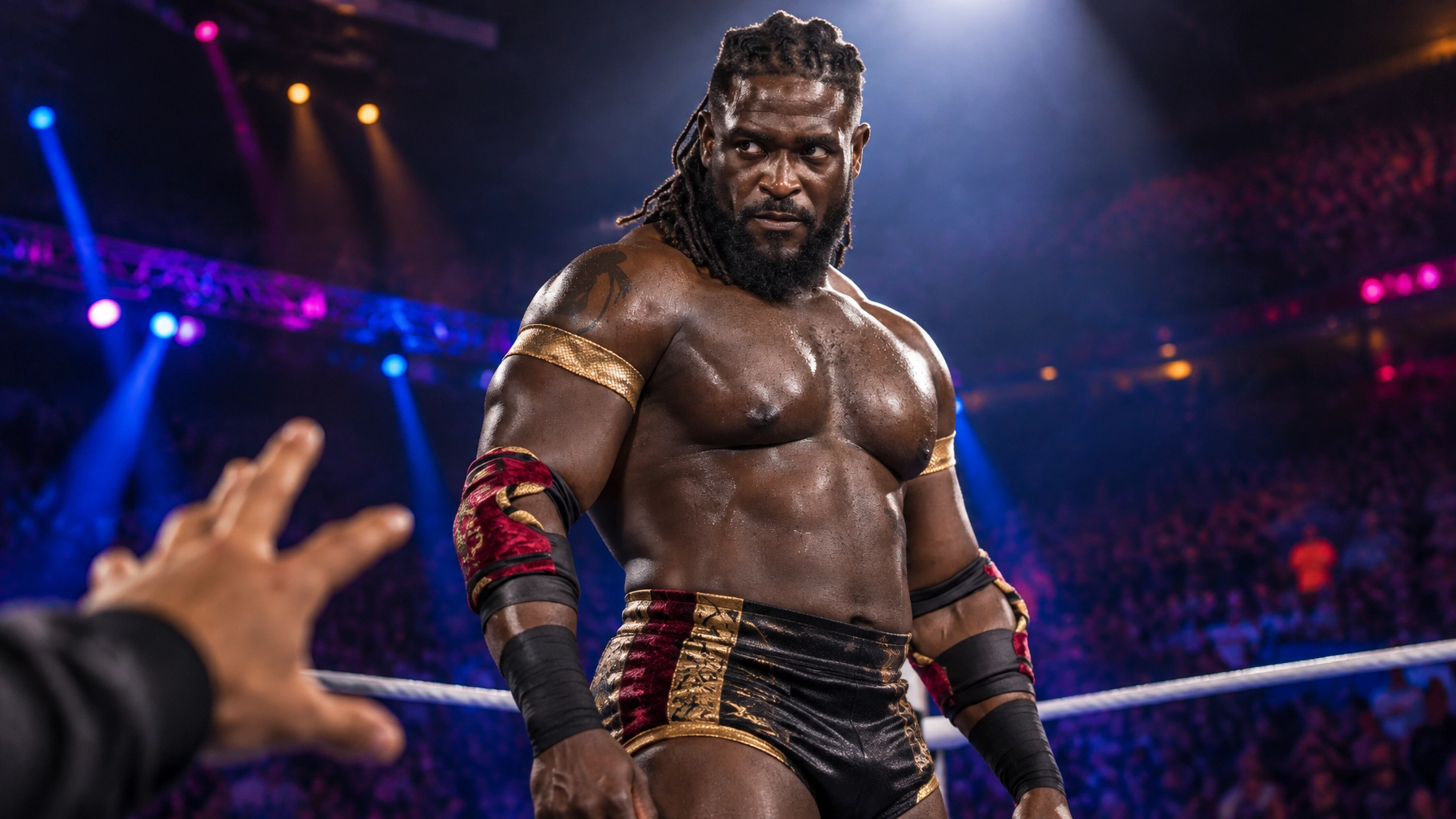
On Monday Night Raw, a hand was offered, and Oba Femi turned away from it.
In a moment that instantly changed the conversation around WWE’s rising powerhouse, Femi rejected Paul Heyman’s offer of an alliance on the October 12, 2026, episode of Raw. Heyman has spent decades standing beside some of professional wrestling’s most formidable stars. Femi’s answer was clear: he would not borrow another man’s identity to build his own.
“I’m not Brock Lesnar, I’m not Roman Reigns. Those are Paul Heyman Guys. I am an Oba Femi guy!”
The declaration landed like a bombshell. For fans following the latest wrestling news, this was more than a memorable line. It was a major storyline development, and a defining statement about the kind of star Femi intends to become.
A refusal that shook the ring
The moment came after Femi celebrated his victory over Bronson Reed at Money in the Bank. Femi spoke with the authority of a man who believed the result had made his message unmistakable: Reed had learned that everyone would bend the knee, and Femi was leaving The Vision behind as he pursued his destiny.
Then Heyman appeared.
The legendary advocate praised Femi, pointing to his ability to withstand Reed’s Tsunami and describing him as a major part of WWE’s future. As Heyman began to offer his services, Femi took the microphone from him and threw it out of the ring. He followed with his blunt rejection, then walked away.
No handshake. No agreement. No hesitation.
For viewers who follow WWE results for more than the winners and losers, that sequence delivered the night’s deeper story. Heyman did not simply offer help; he offered the kind of alliance that has historically signaled a performer’s arrival in the main-event conversation. Femi understood the weight of the offer, and declined it in front of the world.
The rise of a physical anomaly
Femi’s confidence did not appear overnight. As a dominant former NXT Champion, he built his reputation through a presence that made opponents look smaller before the bell even rang. His broad, powerful frame and composed intensity gave him a rare physical authority: he did not need to rush to seem dangerous.
That sense of inevitability became part of his appeal. The violence of his offense, the force behind his movement and the calm he carried into confrontation suggested a performer who could control the temperature of a match simply by stepping into the ring. His rise drew comparisons to the era-defining monsters of WWE history, not because his path was identical to theirs, but because he possessed the scale and bearing audiences associate with generational forces.
Those comparisons are flattering. They are also a challenge. Femi has to establish what makes him singular, not merely echo the legends who came before him.
On Raw, he made that distinction himself.
Opinion: Femi chose identity over an instant shortcut
The refusal says, in my opinion, that Femi’s character is being shaped around self-belief, not just dominance. A monster who accepts an advocate can still be compelling, but a monster who insists that his name is enough creates a different kind of tension. He is not claiming the road will be easy. He is saying the road belongs to him.
That matters for his booking direction. WWE has positioned Femi as a rising force, and this exchange gives the audience a clear question to follow: can he turn extraordinary presence into lasting top-guy status without a powerful representative steering the story? The answer cannot come from one promo. It must be earned through consequential matches, meaningful rivalries and victories that make his independence feel credible.
There is also a risk. Going alone can make a star look isolated if the company does not surround him with worthy opposition. If Femi’s refusal is to feel monumental rather than merely dramatic, the next chapters must test his conviction. The audience should see that he turned down an advantage, not that the offer never mattered.
That is the difference between a catchphrase and a character statement.
Heyman’s pattern, and what Femi turned down
Heyman’s history makes the refusal especially potent. His associations with Brock Lesnar and Roman Reigns are among the most prominent examples of a manager-advisor amplifying an already imposing star. His connection to CM Punk represents another chapter in a long career spent aligning himself with performers whose ambitions could command a room.
An alliance with Heyman could have offered Femi a proven advocate, a sharper verbal foil for opponents and a ready-made way to frame his pursuit of the top of WWE. Heyman’s presence can make a confrontation feel bigger before the bell rings. His words can turn a championship chase into a campaign and make an opponent’s confidence sound like a threat.
But the same history carries a shadow: when Heyman is beside you, the audience may wonder whether the power belongs to the wrestler, or to the man speaking for him.
Femi’s rejection cuts directly through that uncertainty. He knows the legacy of a “Paul Heyman Guy.” He also knows he is not required to become one. That distinction gives this Raw segment its lasting charge: a rising star was offered a shortcut with a legendary name attached and chose to stand alone instead.
Fans and peers alike will debate whether that was bold or premature. The universe will be watching to see what he does next.
Opinion: The harder road can become the mythic one
Going alone is not automatically nobler, and independence does not guarantee success. It is simply harder to sustain. Without Heyman’s protection or strategic voice, Femi must make every step register through his own actions. His promos, his matches and the way he responds when an opponent finally pushes him to the brink all become part of the proof.
That difficulty is precisely why the choice could become mythic. Wrestling history is filled with defining moments in which a performer either accepted help or insisted on walking forward under their own name. If Femi’s path is booked with patience, his rejection can become the first chapter of a larger legend: the night he turned down an open door because he intended to break one down himself.
The key word is patience. A top guy is not made by a single dramatic refusal; he is made when the next challenge feels bigger, the stakes rise and the audience believes the answer might not be guaranteed. Femi needs resistance that exposes more than his strength. He needs opponents capable of testing his judgment, stamina and composure.
That is where the next program matters.
Opinion: Give Femi a rival who can make him prove it
In my opinion, Femi’s next program should put his independence under pressure without immediately undoing the choice he just made. A credible rival should challenge his claim to be an “Oba Femi guy” by forcing him into situations where raw power is not enough. The story should give Femi obstacles he cannot simply overwhelm in seconds, and let him find the answer himself.
A sustained rivalry with another physically imposing contender could make his dominance feel earned rather than automatic. The opponent should be dangerous enough to threaten the momentum Femi gained against Reed, but distinct enough to avoid feeling like a repeat. Every encounter should reveal a new layer: how Femi handles provocation, whether he can adjust when his first attack fails and how much punishment he can absorb before that composed expression cracks.
Heyman does not have to vanish from the story, either. His offer can remain a shadow at the edge of the frame. He might watch Femi’s progress, revisit the conversation or try to prove that independence has a cost. But the central question should stay with Femi: can he achieve what Heyman promised without Heyman beside him?
That is stronger than rushing into a new alliance or granting an effortless march to the championship.
The next top guy will have to prove it
In the fast-moving world of pro wrestling news, a dramatic Raw moment can dominate the conversation for a night. The more important question is what follows. Femi has made his position unmistakable; WWE now has the opportunity to turn that refusal into a sustained journey, one where every victory strengthens his identity and every setback tests it.
For the audience, this is the promise of a story worth debating long after the microphone hits the floor. The next top guy may have just rejected a shortcut. Now he must prove that the harder road leads somewhere worthy of the name he chose.
Oba Femi is not asking to be remembered as somebody else’s project. He is demanding the chance to become a legend on his own terms, and the next chapter will show whether WWE is ready to let him.